When Gloriously Messy Meets Frazzled Engishwoman
Jan 31, 2026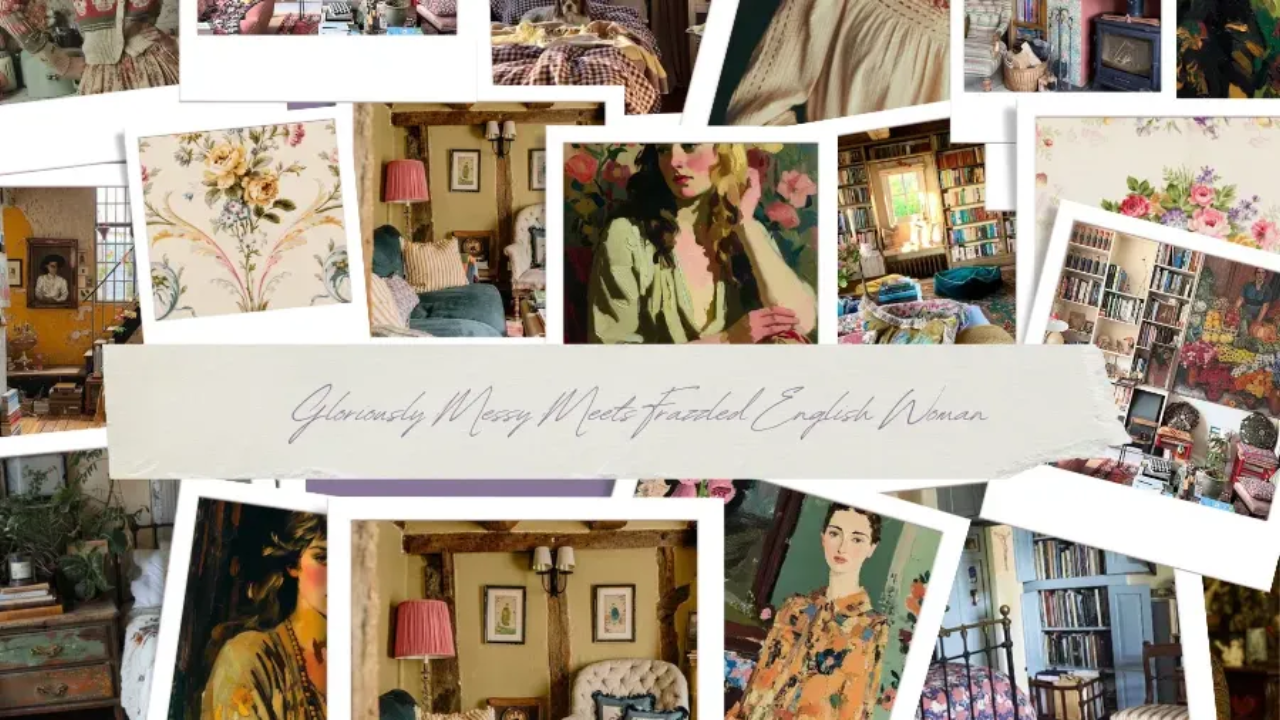
There’s a certain irony in watching TikTok discover what some of us have been accidentally living for decades. The “frazzled English woman” aesthetic, has been having what the internet calls a moment, for a couple of years now. Which is to say, it’s being photographed, hash-tagged, and ultimately, performed.
Those of us who’ve been actually frazzled, rather than aesthetically frazzled, are watching this development with the kind of complicated relief you feel when someone finally admits they understand something you’ve been saying all along, whilst simultaneously packaging it for algorithmic consumption and totally stripping it of context.
Twenty-one years ago, when I started BrocanteHome, this aesthetic was simply called vintage. Or sometimes shabby, if you were being generous with the pale florals. More often, it was called scruffy because the cultural conversation around domesticity was still dominated by the tyranny of minimalism, something that ultimately became the Marie Kondo fantasy of perfect control, and the Kinfolk aesthetic of empty surfaces and muted palettes. We were meant to be aspiring to white walls and the conspicuous consumption of emptiness, to homes that looked like nobody actually lived in them. Ushering in what I suppose is a sort of aesthetic Calvinism: the belief that virtue could be demonstrated through renunciation, and that the good life was always a sparse one.
But some of us were yearning for something else entirely. For Elizabeth David’s kitchen with its earthenware and copper, her insistence that cooking was an intellectual pursuit worthy of serious prose. For Bloomsbury style domesticity - Vanessa Bell’s painted furniture at Charleston, the beautiful chaos of artistic households where Duncan Grant’s canvases jostled with Clive Bell’s manuscripts. About that particular strand of English bohemian living that runs through Virginia Woolf’s diaries and Vita Sackville-West’s gardens at Sissinghurst, where intellectual life and domestic life weren’t separate territories but deeply and inextricably intertwined.
The golden age of domesticity: that strange post-war period when women were meant to find complete fulfilment in perfect housekeeping, had given us women’s magazines at their most preachy, spewing the fantasy that domestic perfection was both achievable and desirable to such excessive degree, so that by the time feminism had its second wave, we’d collectively rejected the whole palava. Betty Friedan may have taught us that the feminine mystique was a trap, but we’d also, somehow, rejected the value of domestic life itself, throwing out the baby of lived experience with the bathwater of oppressive expectations.
I came after all of that. Hot on the heels of my Mum, who simultaneously rejected even the notion of domesticity, while in her own mind, felt thoroughly trapped by it. So there was something borne in me that turned out to be the reclamation of domesticity on my own terms. Not as performance, not as perfection, or even ssomething to be resented, but as what Rachel Cusk calls “the work that makes all other work possible.” The real, unglamorous, essential labour of making a life.
The Gloriously Messy Philosophy, Unpackaged
The gloriously messy philosophy isn’t new. It’s a direct line from Bloomsbury aesthetics, from Nancy Mitford’s Curzon Street flat with its battered sofas and first editions, from the way Elizabeth Jane Howard lived: good furniture slowly going to seed, excellent wine served in whatever glasses were clean. It’s Iris Murdoch’s chaotic North London house stuffed with books and cats and philosophical arguments conducted over burnt dinners. And it’s Jeanette Winterson’s insistence that domestic life and artistic life are the same life, that there’s no separation between chopping vegetables and writing sentences. That beautiful blur I have long struggled to put into words of my own, knowing only that for me work and home were one and the same thing.
This philosophy extends back further still: to Gertrude Jekyll’s approach to gardens, where beauty emerged from seeming chaos. To the aesthetic movement’s rejection of Victorian propriety in favour of lived-in beauty. To every English woman who understood that layers tell stories, that complexity is more interesting than control, and that a life of the mind requires a certain amount of domestic disorder because tidiness takes time that could be spent reading, writing, and thinking.
It’s Georgian tables coexisting with Turkish market rugs. Laura Ashley curtains from 1994 that needn’t be replaced simply because they’re no longer fashionable. A stove that’s been the beating heart of a kitchen since the Blair years, perpetually covered in evidence of actual cooking rather than styled vignettes. Moroccan bowls from a trip in the early 2000s sitting alongside inherited Wedgwood, because the anthropologist in us understands that domestic spaces are archaeological sites, each object a stratigraphic layer revealing how we’ve lived. Who we are to found in the stacks of our days piled haphazardly wherever domestic nature forms them.
Currently, I’m living in a house mid-renovation that we’re selling. Every surface is temporary. The plumbing is questionable at best. Nothing matches because nothing’s meant to be permanent. Because the good things are packed away. Everything that isn’t purely functional simply non-existent within these four walls so there is nothing of beauty on which the eye can really come to rest. So I’m aching, actually physically aching, for my own version of the frazzled woman’s dream. A proper kitchen with plumbing that doesn’t require negotiation. A walnut wardrobe filled with clothes that won’t need to be packed again in three months. Space for my books that isn’t provisional, that acknowledges reading as essential infrastructure rather than decorative choice.
The homes and gardens magazines are currently celebrating precisely this chaos with their perfectly frazzled interiors. Meanwhile, I’m living the reality: the actual disorder of displacement, of making do, of trying to write about domestic sovereignty whilst having none of my own. Rather like being asked to write about swimming whilst drowning, the irony isn’t entirely lost on me, but I’m just too tired to fully appreciate it?
The frazzled English woman aesthetic is what this philosophy looks like when it’s been filtered through TikTok’s algorithmic attention economy, styled for House & Garden’s editorial calendar, and presented back to us as discovery rather than recovery. It’s the visual manifestation of a truth that women in their forties and fifties have known for years: perfection is exhausting, impossible, and ultimately boring.
The Interior We’ve Always Inhabited
The kitchen I’m dreaming of, the one I’ll have when we’re done with the selling and the moving, will almost certainly not feature an AGA. It likely won’t be sprawling. It might be in a city apartment rather than a country cottage, compact rather than generous, vertical rather than horizontal. But the accidental intention will be the same. The aesthetic, if we must call it that, remains constant regardless of square footage or postcode. Whether it’s a two-bedroom flat in a Victorian conversion or a small cottage with low ceilings, the philosophy adapts without diluting.
There will be a table, made from elm if I’m lucky, and pine if I’m practical. The kind that takes decades of use and only gets better. Some form of shelving, a dresser if space permits, displaying Burleigh pottery alongside those Moroccan bowls from the early 2000s, my Mum’s Christmas dinner service, and the accumulated detritus of a life lived with priorities other than visual coherence.
There will be a sitting room with a plump velvet sofa, probably bought for a song , definitely lived-in (thought not as lived in as the glorious Liberty mustard yellow one we bought last year, now destroyed by muddy spaniels). William Morris cushions, fighting for space with needlepoint treasured by a stranger’s grandmother. Walls thick with art: My naive portaits’s of stout chldren, a terrible junk-shop watercolour, a landscape painted by my Dad, and a child’s drawing, because curation is less interesting than accumulation. A bookcase housing Anita Brookner and Angela Carter, Penelope Fitzgerald and Rosamond Lehmann, Hilary Mantel and Sarah Waters, arranged by no system more sophisticated than spatial availability and the occasional thematic cluster that emerges organically, and is quietly celebrated everytime I find myself standing in front of laden bookcase, happy that mine has always been a life decorated with words.
A mantelpiece, if there is one, functioning primarily as a horizontal surface for invitations that I can’t quite throw away, postcards from the National Portrait Gallery, and a sturdy clock to beautiful to discard. This is what Donald Winnicott would call a transitional space, neither entirely functional nor entirely decorative, but holding the tension between use and beauty. Between our inner worlds and the objects we need to plant us in time and space.
This isn’t shabby chic, which requires both intention and a Farrow & Ball budget (Elephant’s Breath, presumably, or perhaps Pigeon). This is what happens when you prioritise living over styling, when you understand that patina is what Walter Benjamin called “the aura,” the evidence of time and use that separates authentic objects from their reproductions. When you’ve read enough Bloomsbury diaries to know that the most interesting people have always lived this way, that Virginia Woolf’s writing room at Monk’s House was a glorious mess of manuscripts and cigarette ash.
The World of Interiors has always understood this better than House & Garden ever could. Their version of the frazzled English woman, with its unusual interiors and genuinely literate approach, has always been truer than the manicured fantasies you find in magazines that prioritise visual coherence over lived reality. World of Interiors has spent four decades mixing high and low, historical and modern, ecclesiastical and domestic, understanding that “startlingly beautiful things” can coexist with genuine chaos. They’ve always known that the most interesting spaces are created by artistic bohemian types rather than data-driven stylists.
House & Garden is now calling this “layered English style,” as though they’ve discovered a new colour rather than simply noticed what’s always existed. The December 2022 Vogue featured it under “An Actual Frazzled Englishwoman Dissects the Trend,” commodifying authenticity even as it claimed to celebrate it. TikTok is obsessing over it with the intensity it previously reserved for clean girl aesthetic and coastal grandmother, each trend cannibalising the last in the endless churn of content. Interior designers are being quoted about antique brass hardware and the resurgence of lived-in luxury, as though luxury could be anything but lived-in without becoming mere display. Pinterest searches have surged by 1,000% year-on-year, which tells us more about Pinterest’s algorithm than about actual domestic life.
When I started writing about this in the early 2000s, during Britain’s brief flirtation with Cool Britannia and just before the financial crash would make austerity the new aesthetic, it was called vintage at best, untidy at worst. Now it’s trending because the wheel never stops turning, and latterly seems to be gathering speed: consume, spit out, repeat.
The Women Who Showed Us How
British cinema has always given us these women, we’ve just been too busy calling them eccentric to recognise them as a tradition, a lineage, a way of being that constitutes genuine cultural knowledge. Emma Thompson in Sense and Sensibility, channelling Jane Austen’s own domestic reality: a woman writing masterpieces at a small table in the drawing room whilst the household chaos swirled around her, her genius emerging not despite the domestic context but within it.
Kate Winslet in The Holiday, inhabiting a Surrey cottage that’s essentially a film set version of what Rosamond Lehmann’s actual houses looked like, or Elizabeth Bowen’s Bowen’s Court before it was demolished, beautiful, crumbling, full of books and ghosts. Juliet Stevenson in Truly, Madly, Deeply, grieving in a North London flat that could be Iris Murdoch’s house in Charlbury Road (currently for sale!), books, scarves, evidence of an intellectual life lived without apology, where philosophy and domesticity occupied the same conceptual space.
Kristin Scott Thomas in Four Weddings and a Funeral, all cut-glass accent and beautiful tailoring with something perpetually undone, like Diana Mosley before the fascism, or Nancy Mitford before the exile. Helena Bonham Carter in everything, channelling that particularly English combination of eccentricity and elegance that runs from the Sitwells through Edith Sitwell’s fur coats and medieval jewellery to now, a tradition of women who understood that conformity was the enemy of both thought and beauty.
Olivia Colman’s Queen Anne in The Favourite captures something essential about female power and vulnerability coexisting in the same body, the same quality you find in Antonia Fraser’s historical subjects, women who were simultaneously formidable and falling apart. More recently and less socially highbrow, Dawn French in the sitcom Can We Keep a Secret? inhabiting a house that’s the platonic ideal of frazzled English domesticity: beautiful, cluttered, lived-in to the point of archaeological significance, where every surface tells a story and nothing matches because matching was never the point, and Olivia Coleman again, playing a music teacher in Flowers, where the house tumbledown and chaotic and somehow still visually stunning, reflects the family’s collective depression. So too, Carey Mulligan in An Education, learning that sophistication and disaster can wear the same clothes. Judi Dench in Notes on a Scandal, demonstrating that intelligence doesn’t preclude chaos, though perhaps it requires it.
These weren’t caricatures. They were in direct lineage with actual English women of letters and influence who lived in beautiful chaos because they were too busy being interesting to worry about whether everything matched, too intellectually serious to waste time on domestic performance.
A Personal History of Being Perpetually Undone
I haven’t arrived at this aesthetic as trend adoption or mid-life crisis. I’ve been genuinely frazzled since approximately 1995, when I realised it was possible to care deeply about both A.S. Byatt and batch cooking, both Seamus Heaney and seasonal living, and that keeping everything completely organised simply wasn’t compatible with maintaining an intellectual life, no matter how many routines and rituals I tried to hammer into my days, because the brain space required for perfect domestic order is the same brain space required for reading Possession or understanding The Death of the Heart and there are only so may hours in a day? Because too, the women I did know with immaculate houses, didn’t house countless stupid amounts of books, or spends days squirrelled over journals trying to fashion words into meaning. They lived and they cleaned and they organised, but try as I might to live like that, we were simply not the same. I was. not superior, just different: frazzled in a head awash with frantic theory, while they were serene with quiet purpose and clarity of purpose, and never the twain would meet.
When I started BrocanteHome in the early 2000s, the domestic landscape was dominated by minimalism and the Martha Stewart fantasy of domestic perfection as moral achievement. The feminist project, in its necessary rejection of the feminine mystique, had been to reject domesticity entirely. Which meant we’d lost the thread that connected us to women like Elizabeth David, who wrote about food and domesticity as genuine intellectual pursuits worthy of the same attention as literature or politics.
We’d lost Constance Spry, who understood flowers as art before art historians would admit it. We’d lost the entire tradition of women who’d made domestic life into something worth writing about: not in the Good Housekeeping sense of instruction and perfection, but in the sense of what Rebecca Solnit calls the real work of living, the unglamorous essential labour that makes everything else possible. Housework and interiors blended into one revered pursuit and there wasn’t room for the chaos that comes with creativity, so performance of housewifery swept away authenticity and too many belongings, proof of soul and spirit, became threat to order and conformity.
I was never quite on-board because I’ve spent two decades as the woman who arrives places in yesterday’s mascara, not as a style choice but because I was reading late and morning came too soon. I’ve hosted dinner parties where the starter is ambitious and the main is Aldi, served with equal confidence because the artificial hierarchy between homemade and bought is another form of domestic oppression. I’ve carried the good handbag with the broken clasp, the cashmere jumper with the moth hole, and swung the vintage scarf, high enough around my neck to cover my mouth, (in the hope that too many words will not come slipping out). All of it, not as performance, or even fashion, but because these were the good things I owned and I was too busy actually living, reading, writing, working, mothering, to curate a perfect version for public consumption.
My bookshelves, when I have proper ones again, when this nightmare ends and I’m no longer living in provisional hell, will never be organised by anything more sophisticated than what fits where and occasional thematic clusters that emerge organically. Iris Murdoch next to Nigel Slater, Anita Brookner beside Nigella Lawson, because the division between high and low culture is a false one perpetuated by people who’ve never had to actually live. Maggie Nelson’s Bluets next to Tamar Adler’s An Everlasting Meal (I do insist you read this one), because colour theory and cooking belong together, don’t you think?
When I started writing about the gloriously messy philosophy, I wasn’t issuing a manifesto so much as documenting what was already true and connecting it to a tradition that predated us both: the tradition of English women who refused to choose between domestic life and intellectual life, who understood that both could be pursued with equal seriousness, that thinking and cooking and reading and cleaning were all part of the same essential human project of making meaning from matter.
As philosophy, it arrived in fragments, in the mess and the realisation that the performance of perfection had been exhausting since the Thatcher years, when aspiration became the national religion and domestic display was reimagined as personal achievement.
And I was finally done: the irony being that I think it was as my mind finally frazzled into truth in an environment where there was no choice but to focus wholly not on aesthetics, but on books and words and theories, that I was finally able to understand what had been nagging me all along.
When the Aesthetic Finally Catches Up
What’s both gratifying and mildly irritating about seeing the frazzled English woman aesthetic everywhere now, is that it represents culture finally catching up to what some of us have known all along.
We never needed permission to be this way. We’ve been doing it regardless, often entirely without premeditation, whilst being made to feel vaguely apologetic about it, as though living fully were somehow a moral failing. But there’s something validating about having the arbiters of taste finally admit that a house that looks lived-in is better than one that looks like a showroom, that a woman with interesting layers is more compelling than one who’s got it all tidily together and that complexity is more interesting than the performed simplicity of minimalism.
The gloriously messy philosophy and the frazzled English woman aesthetic are the same truth expressed in different languages, different media and different economies. One is internal acceptance, rooted in a historical understanding of how interesting women have always lived: messy, complicated, intellectually serious and domestically chaotic. While the other is external performance, filtered through social media’s attention economy and styled for maximum engagement, packaged for consumption rather than lived experience.
Both celebrate complexity. But only one requires a ring light and a content calendar, only one is subject to the tyranny of social media platforms, where everything must be constantly produced, updated, refreshed, and made new even when the whole point is supposedly to celebrate the old.
Living It Without Performing It
If you’re sitting there thinking you’ve been like this all along, you’re correct. You’ve been in a tradition that stretches back through Bloomsbury, through Victorian bohemians like Dante Gabriel Rossetti’s circle, through every woman who’s understood that a life of the mind requires a certain amount of domestic disorder because time is finite and choices must be made about how to spend it.
The way to live this, rather say than perform it, is to stop asking for permission and to understand that you’re part of a lineage, not a trend. Your home tells your story. Those books piled everywhere exist because you read, because reading is essential infrastructure not decorative choice. The fabric waiting to be made into curtains, the seeds waiting to be planted, the half-finished projects, these are merely evidence of a creative, ambitious, curious life, not proof of failure. What looks like chaos to the outside eye is actually sophisticated priority-setting: you’ve chosen reading over tidying, thinking over organising, living over curating.
So mix your eras without apology, un-compromised by historical awareness. Georgian table, Victorian dresser, mid-century modern chair, that rug you bought on holiday in Morocco. Your home should look like you’ve lived, traveled, inherited, collected: a material autobiography, an archaeological site of accumulated experience. Even if most of that travel has been to car boot sales in Liverpool, which are themselves archaeological sites of other people’s domestic histories.
Wear your good things daily. Your grandmother’s pearls whilst gardening, as Vita Sackville-West did. Your good coat over a jumper from the charity shop. This mixing of high and low isn’t styling; it’s understanding that the division between them is artificial, a class marker that has nothing to do with actual beauty or utility. It’s what Pierre Bourdieu called challenging “the logic of distinction”: refusing to participate in the social game of taste as status marker.
Keep flowers. Even if they’re past their prime, even if the vase is actually a jug, even if you’ve forgotten to change the water. Elizabeth David did this. Constance Spry wrote books about it. Vita Sackville-West understood it as essential. Fresh flowers, or freshish flowers, say you’re still trying, which is more honest than pretending you’ve achieved some permanent state of perfection. They’re also memento mori, reminders that beauty is temporal, that decay is natural, that entropy is the law. Proof of life despite evidence of death.
Accept the patina. Your copper pans have oxidised like the ones in Elizabeth David’s kitchen. Your linen is soft from years of washing, like the napkins at Charleston. Your wooden table bears marks from decades of use: cigarette burns, wine rings, knife scores, each one a story. Your face has lines from years of living. Patina is what makes things beautiful. It’s what separates the authentic from the performed and the lived from the staged.
Have more books than shelf space. Nancy Mitford did. Iris Murdoch certainly did. Virginia Woolf famously did. Stack them horizontally when vertical space runs out, pile them by the bed in geological strata of reading intention, use them as impromptu side tables. They’re not clutter. They’re evidence of an examined life, material proof that thinking IS work, and that intellectual life requires physical infrastructure.
Waiting for the Moment to Pass
The truth is, those of us who’ve been living the gloriously messy philosophy for decades are watching this aesthetic moment with complicated feelings. It’s validating to be told we’ve been right all along, that what we’ve been doing for years is suddenly desirable. It’s also exhausting to watch something genuine, something we almost could not help, and something rooted in a real tradition of English women’s domestic and intellectual life, get turned into content, flattened for algorithmic consumption, and stripped of context and history and meaning.
So there’s a part of us that will be quietly relieved when the frazzled English woman aesthetic moves on to whatever comes next in the endless churn of trends. Not because we don’t want the validation, but because we’d quite like our actual lives back. The messy bits, the unstylish bits, the bits that don’t photograph well in good light or translate to TikTok’s vertical video format. The bits that require actual plumbing and aren’t provisional, that can’t be performed because they simply are and do not translate well to the proliferation of dreamy, ethereal and oh so edited “day in the life” videos now purporting as domesticity.
We’re women in our fifties now. We’ve earned every bit of our beautiful chaos through decades of living, reading, thinking, working. We’ve lived enough life to know that perfection is boring, impossible, and not remotely desirable. We’ve read enough, Woolf and Murdoch, Brookner and Carter, Mantel and Waters, to understand we’re part of a tradition, not a trend. That what we’re doing has intellectual lineage and historical weight and that it means something beyond aesthetic performance, because it has to, or heavens to Betsy, tell me, what was the point?
The frazzled English woman aesthetic is having its time in the algorithmic sun. But we’ve been having ours for decades, long before anyone thought to give it a name or a hashtag or a Pinterest board with 1,000% year-on-year growth. We’ll still be here when the moment passes, when TikTok moves on to whatever’s next, when the content creators need fresh material and the aesthetic magazines need new features.
The aesthetic will move on, but we will remain. Gloriously, authentically, unapologetically messy. Creating accidental vignettes of beauty, born purely of a well-trained eye and a need always to surround ourselves with proof of who we are, and rooted in a tradition that understand domestic and intellectual life as inseparable, and that recognise perfection as both impossible and undesirable. Part of a lineage that runs from Bloomsbury through to now, from Virginia Woolf’s cigarette-ash-covered manuscripts to Elizabeth David’s earthenware bowls to the old reclaimed table I once owned, covered in books and crumbs and half-finished cups of tea. God how I miss it.
So when when we’ve moved and I finally have my own version of the frazzled woman’s dream, with plumbing that works and shelves that aren’t fashioned from the deep skirting boards here, it likely won’t look like the cottages on TikTok or the Georgian townhouses in House & Garden. It might be smaller, more urban, and almost certainly compromised by practical realities like budgets and availability. But I’ll be living it as it was always meant to be lived, scaled to whatever space I inhabit. Not as content. Not as aesthetic. Not as performance for algorithmic consumption. But as life itself, in all its beautiful, complicated, intellectual, domestic, gloriously messy reality.
The same philosophy, just differently housed.
Library Member? Visit Our Exclusive Community Here...
Join the Joy List
All things BrocanteHome. Weekly to Your Inbox
We hate SPAM. We will never sell your information, for any reason.